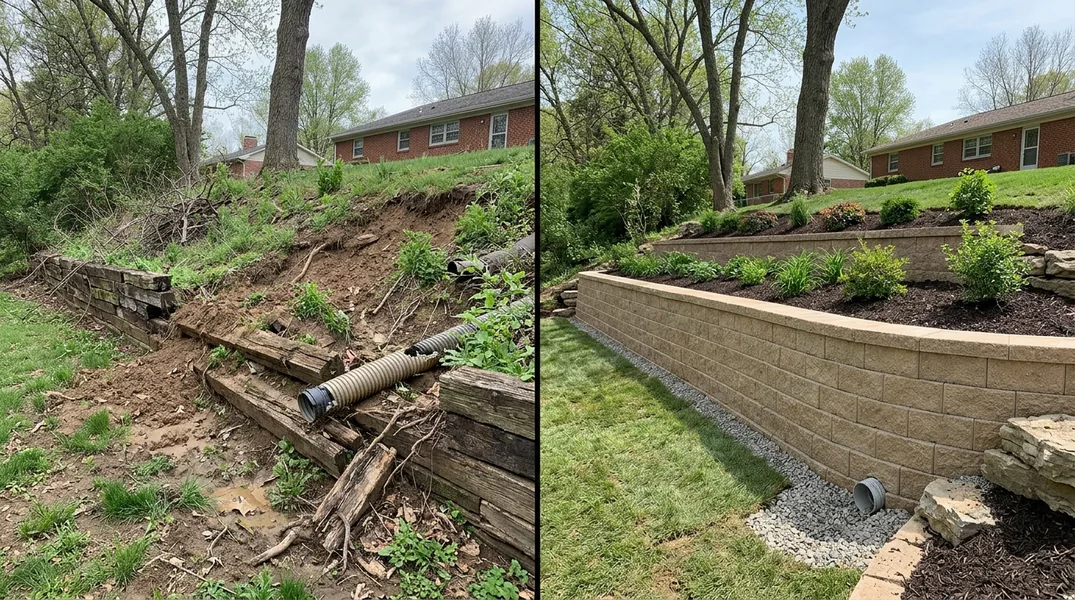
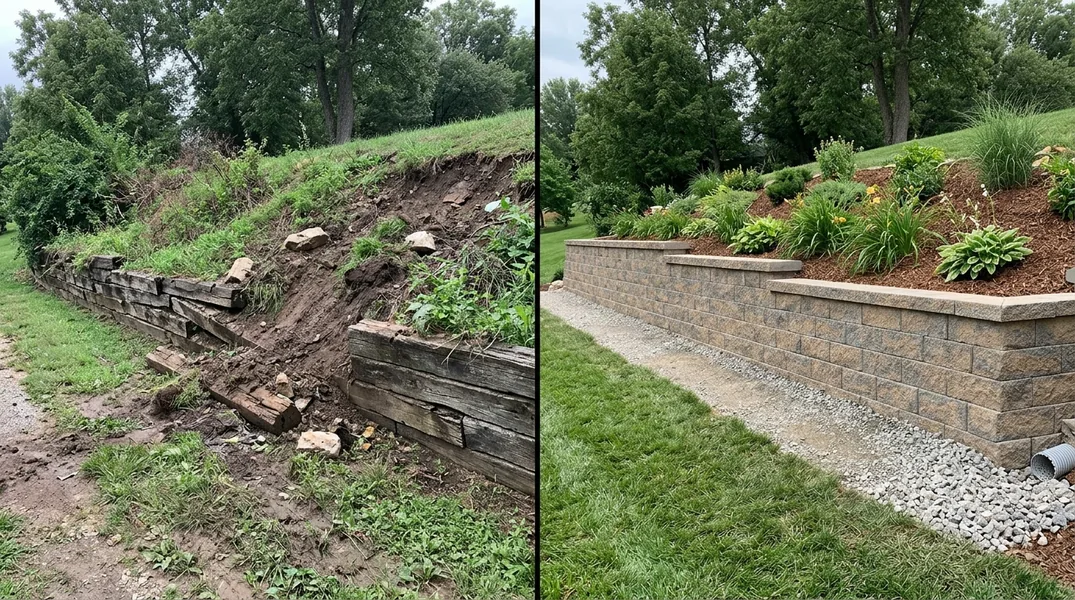
Retaining Wall Contractor in Lexington, KY
Homeowners searching for a retaining wall contractor near me in Lexington want a crew that understands why walls fail here, not just how to stack block. Lexington Retaining Wall is a network of fully insured local contractors who build, repair, and replace retaining walls on the sloped and hillside residential lots that define the Inner Bluegrass. From the brick townhouses around Gratz Park to the rolling yards of Ashland Park, Chevy Chase, Southland, and the newer subdivisions in Hamburg and Masterson Station, we work with the same stubborn ground conditions: thin silty topsoil over sticky expansive clay, shallow limestone, and sinkhole-prone karst. That clay is the number one wall killer. When it saturates, it swells and pushes; when drainage fails, saturated backfill loads the wall beyond design. Our crews serve Lexington, Georgetown, Nicholasville, Richmond, Winchester, and the surrounding Bluegrass region. If you are ready to talk through a failing wall or a new build, start with a free estimate.
We handle the full scope of residential retaining wall work: new installation on grade changes and hillside lots, structural repair for walls that are leaning, cracking, or bulging, and full replacement when a wall is past saving. Because so much of Lexington sits on clay that moves with every wet spring and freeze-thaw winter, we treat drainage as part of the structure, not an add-on. That means gravel backfill, filter fabric, French drains, and weep holes are planned from the first day, not patched in after a wall starts to move. Whether your property is a 1920s Tudor on a curving Chevy Chase street or a two-story in Beaumont with a terraced backyard, the goal is the same: a wall that sheds water, holds its line, and matches the site.
Retaining Wall Repair & Failure Diagnosis in Lexington
Most retaining wall failures in Lexington start with water. When backfill saturates and the clay soil expands, hydrostatic pressure builds behind the wall with nowhere to go. A wall that was plumb in July can be leaning and bowing by the next wet spring. Missing or clogged weep holes and failed French drains make it worse, because water that should exit through the drainage aggregate instead sits against the wall face. Cracking and bulging in block walls often trace back to the same pressure, sometimes combined with missing geogrid reinforcement or poor compaction of the backfill lifts. Sinking and settling usually point to an undersized footing or soil that was never compacted properly, and a wall that collapses after heavy rain is the end stage of a problem that was visible months earlier. If you see a lean, a crack, or a bulge, call (859) 710-8778 before the next storm season.
Ignoring a small lean is how homeowners end up with a collapsed wall. As a wall tips, it loses contact with the soil that was holding it, which shifts more load onto the remaining section. Cracks let more water in, which accelerates settlement and pushes the wall further out of alignment. A repair that might have involved tieback anchors, recompaction, and new drainage can turn into a full rebuild once the footing moves or a section shears. That is why we assess the whole system, not just the visible face: the footing, the backfill, the drainage path, and the surcharge load above the wall, whether that is a driveway, a patio, or a structure.
Our retaining wall repair work covers leaning and bowing walls, cracked or bulging block, settled sections, and walls that have slid or partially collapsed. For severe movement, we may recommend leaning and collapsed wall repair with tieback anchors or reconstruction of the failed section. The first step is a site visit to identify what is actually driving the failure. Request a free estimate and we will tell you honestly whether your wall can be stabilized or should be replaced.
Retaining Wall Materials We Build With in Lexington
The right material depends on the site, the height, and how the wall needs to perform. Block and segmental retaining walls (SRW systems such as Allan Block, Versa-Lok, and Keystone) are the workhorse for most residential grade changes, especially where geogrid reinforcement is needed to tie the wall back into the soil. Concrete retaining walls, including poured concrete and reinforced CMU, suit driveways and structural applications where a surcharge load is present. Boulder and natural stone walls fit the Bluegrass landscape and the dry-laid limestone character of older Lexington properties. Timber retaining walls remain an option for low garden walls, but we are upfront about lifespan: pressure-treated timber has a shorter service life than block or concrete, especially in wet clay.
Every wall we build includes drainage as part of the assembly: gravel backfill, filter fabric, weep holes, and a French drain where the site calls for it. Taller walls get geogrid reinforcement and proper compaction in lifts, and we finish with a wall cap that protects the top of the structure. If your existing wall is a 1970s or 1980s railroad tie terrace, we can talk through railroad tie wall replacement before the timbers rot through and the terrace drops.
How Much Does a Retaining Wall Cost in Lexington?
Retaining walls in Lexington are typically quoted per square foot of wall face, and the range varies widely based on material, wall height, excavation and drainage work, site access, and whether engineered drawings are required. A low garden wall in boulder or timber sits at a different price point than a tall segmental block wall with geogrid and a French drain, and a steep backyard with limited access costs more to build than a flat driveway edge. We frame every figure as a typical range, never a fixed price, because final pricing depends on site conditions. Soil, slope, drainage, and the presence of rock or sinkhole features all affect the scope.
For a realistic starting point, see our pricing page, then request a free estimate so we can walk your property and give you a written scope. We would rather quote accurately after seeing the site than guess from a photo.
Do You Need a Permit for a Retaining Wall in Lexington?
Permit rules for retaining walls vary by jurisdiction, and homeowners should never assume a wall is exempt. In most jurisdictions, walls over about four feet, measured from the footing, require a permit, but thresholds vary by city and by the specific conditions of the site. Commonly, a permit and engineered drawings are needed for taller walls, tiered walls, or walls that support a surcharge such as a driveway or structure. Setback and property-line rules also apply, and they can affect where a wall can legally be placed on a lot. We do not issue permits or provide legal advice; our role is to build the wall to the approved scope.
Because requirements differ and local codes change, always confirm the current rules with the authority having jurisdiction before work begins. Requirements vary, always verify with the Lexington building or planning department before starting your project. If you have questions about how permitting affects your project timeline, contact us and we can point you in the right direction.
Ready to get started? Lexington Retaining Wall serves in Lexington and surrounding areas. Get your free, no-obligation estimate today.
Get a Free Estimate