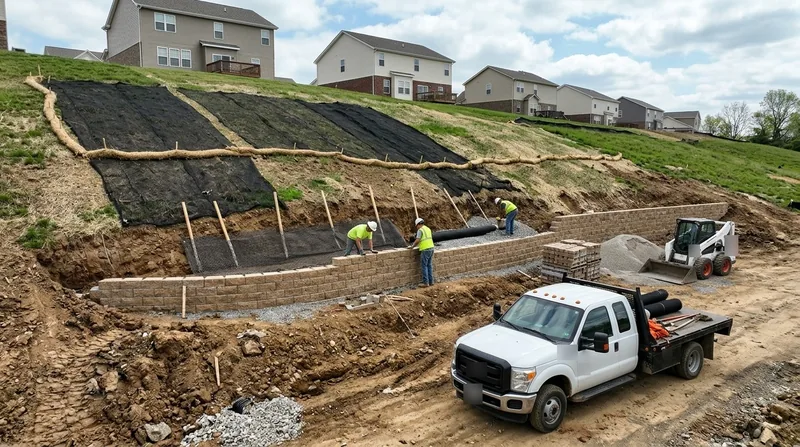




Slope Stabilization & Erosion Control in Lexington
Lexington sits on rolling Inner Bluegrass ground where a thin layer of silty topsoil rests on sticky clay over karst Ordovician limestone. That means sinkholes, shallow rock, and creek swales open up without warning, and the steep palisade cliffs of the Kentucky River gorge to the south put real pressure on any slope. Slope Stabilization & Erosion Control in Lexington is what we do when a yard, driveway, or foundation starts losing ground to water and gravity. Whether you own a 1920s Tudor on a curving street in Ashland Park, a brick ranch in Southland, or a newer two-story in Hamburg, the fix starts with reading the dirt and the drainage. We build terraced walls, set geogrid, and control runoff so the slope holds through freeze-thaw winters and heavy spring rain. Call Lexington Retaining Wall at (859) 710-8778 for a free estimate.
Why Slope Stabilization & Erosion Control Matters on Lexington's Bluegrass Slopes
The clay subsoil under most Lexington lots holds water like a sponge, then swells and shifts when it freezes and thaws. Add a heavy spring rain and a cut-and-fill subdivision lot in Masterson Station or Beaumont, and you get mudslides, undermined driveways, and walls that lean. On the older streets around Gratz Park and Chevy Chase, the problem is often a century of runoff channeled toward a stone garden wall that was never built for it.
- Waterlogged clay pushes retaining walls outward and softens footings until they settle.
- Freeze-thaw cycles crack concrete and CMU walls along driveways and walkways.
- Sinkhole settlement near karst limestone opens voids under patios and wall bases.
- Heavy spring rain strips topsoil from bare slopes and clogs drainage behind walls.
- Creek swales and river bluff edges erode faster once vegetation is cleared.
Ignoring these signals turns a repair into a full replacement, and a small erosion problem into a foundation problem.
Key info: A homeowner in the 40505 area near the North Side watched a railroad tie terrace rot and push forward after one wet spring. By the time it was inspected, the clay behind it had saturated and was creeping toward the back porch. Early stabilization would have saved the terrace and the porch footing.
For official guidance on grading and drainage around structures, the Lexington-Fayette Urban County Government publishes permit and stormwater resources worth reviewing before any slope work.
How We Stabilize a Lexington Slope: Step by Step
We start by walking the slope and reading the water. On a typical job in Versailles or Nicholasville, that means finding where runoff enters, where it pools, and where the clay is already moving. Then we design a fix that matches the grade, the soil, and whatever sits uphill (a house, a driveway, a neighbor's fence).
- We inspect the slope, drainage patterns, and any existing wall or terrace.
- We test the soil and note rock, sinkhole activity, and water table signs.
- We design terraced walls, geogrid reinforcement, and drainage to redirect runoff.
- We excavate, set compacted base, and build the wall or terrace in lifts.
- We install drainage aggregate, pipe, and filter fabric behind the structure.
- We seed, mulch, or set erosion blanket on exposed soil to lock the surface.
Every step is documented so you know what went into the ground and why.
Key info: On a creek-bank lot in Richmond, we terraced a failing slope with two segmental block walls and geogrid, then re-graded the swale to send storm water around the house instead of under it. The homeowner had already lost six feet of yard to erosion in two seasons.
If your slope sits on a tight lot where access is limited, see our 40505 slope stabilization page for how we handle close quarters.
Slope Stabilization Methods We Use in Lexington
No single method fits every slope. The right approach depends on grade, soil, water, and what the slope is protecting. Here is how the main options compare on Bluegrass ground.
| Approach | Description | Best for |
|---|---|---|
| Terraced retaining walls | Two or more stepped walls break a long slope into shorter, stable lifts. | Steep residential yards and cut-and-fill subdivision lots. |
| Geogrid reinforcement | Layered mesh ties the wall back into the clay subsoil for added holding power. | Tall walls and slopes carrying a driveway or structure above. |
| Drainage and dewatering | Aggregate, pipe, and filter fabric move water away from the slope face. | Waterlogged clay and slopes with visible seepage or pooling. |
| Erosion control blanket and seeding | Surface cover holds topsoil in place until vegetation establishes. | Bare slopes, creek banks, and freshly graded ground. |
| Boulder and natural stone toe | Heavy stone at the base resists sliding and scouring on soft ground. | River bluff edges and slopes with shallow rock or sinkhole activity. |
We combine these methods as the site demands, and we tell you plainly which ones your slope actually needs.
Slope Stabilization & Erosion Control Cost in Lexington: What to Expect
Every slope job starts with a free estimate, and that visit is where the real number comes from. A small erosion fix on a shallow grade is a different animal from a terraced wall system holding back a driveway. Cost moves with the length and height of the slope, how much excavation the clay allows, whether geogrid or engineered design is needed, and how tight the access is on lots in Chevy Chase or Ashland Park.
Getting two or three estimates is smart money. It tells you whether a contractor is pricing the drainage or just the wall face, and it protects you from a number that skips the geogrid or the footing. Ask each bidder what they found in the soil and how they plan to move water.
For a fuller breakdown of what drives the number, see our retaining wall pricing overview.
What to Look for When Hiring a Slope Stabilization Contractor Near Lexington
Hiring for slope work near Lexington means hiring for soil, water, and structure, not just block stacking. Ask for proof of licensing and insurance before anyone walks your slope. Get at least two written estimates that explain the drainage plan, not just the wall height. Call references on jobs that look like yours, especially terraced walls or creek-bank work. And check with the local building department on permit thresholds, since walls above roughly four feet or walls supporting a surcharge often need a permit and sometimes engineered drawings.
If your property sits in an HOA subdivision in Hamburg or Beaumont, confirm the architectural review rules before work starts. Heritage trees and protected species on older lots can also affect what you can remove or regrade.
Ready to talk through your slope? Reach out through our contact page and we will set up a free, no-obligation estimate.
Slope Stabilization & Erosion Control in Lexington: Pricing Guide
| Service | Price | Details |
|---|---|---|
| Slope inspection and stabilization plan | Free estimate | On-site walk of the slope, drainage check, and written scope with no obligation to book. |
| Erosion control and surface stabilization | Starting at $1,200 | Erosion blanket, seeding, and minor regrading on small slopes; price moves with square footage. |
| Terraced retaining wall system | Starting at $4,500 | Segmental block or concrete terraces with drainage; height and geogrid needs drive the number. |
| Engineered or large-scale slope job | On estimate | Tall or tiered walls, bluff edges, and surcharge loads need an on-site look and possibly engineering. |
| Travel | Included | In Lexington and surrounding areas, no separate call-out or mileage fee. |
| Estimate | Free | Response within 24 hours at (859) 710-8778, no obligation to book. |
Indicative pricing, the exact cost depends on square footage, finish, and site access. Free personalized estimate within 24h at (859) 710-8778.


