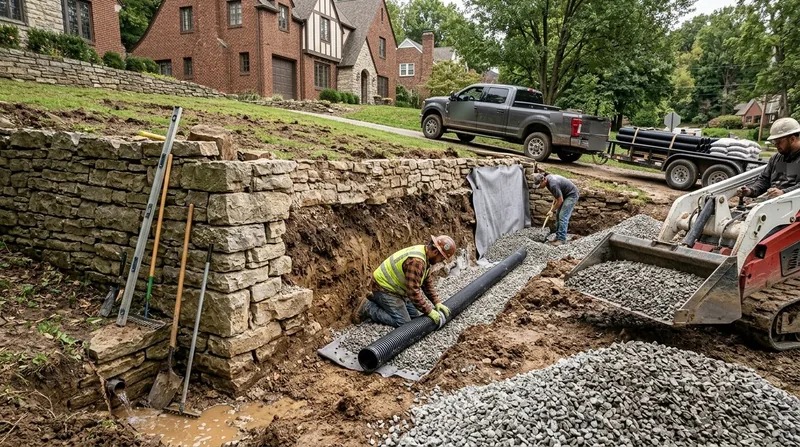




Retaining Wall Drainage in Lexington
If you own a wall in the Bluegrass, you already know the enemy: Retaining Wall Drainage in Lexington is the difference between a wall that stands for decades and one that leans by spring. Our soils are thin silty topsoil over sticky clay, sitting on karst limestone full of sinkholes and shallow rock. Water does not soak away here. It perches on the clay, loads the back of the wall, and pushes. Around Gratz Park and the North Side, that means old brick and stone walls weeping at the joints. In Hamburg and Masterson Station, it means segmental block walls bulging after a wet March. We design and install drainage systems that relieve that pressure before it costs you a rebuild. If your wall is already moving, start with leaning and collapsed wall repair.
Why Drainage Decides Whether a Lexington Wall Survives
Hydrostatic pressure is the number one killer of retaining walls in Lexington, and our freeze-thaw cycles make it worse. Water saturates the clay backfill, freezes overnight in January, expands, and cracks the wall face. When it thaws, the wall drains out and the cycle repeats until mortar joints open and block courses shift. A wall with no gravel backfill and no weep holes is a dam holding back a lake.
- Clay backfill traps water against the wall instead of letting it drain down and out.
- Missing weep holes leave nowhere for water to escape, so pressure builds behind the face.
- Freeze-thaw cycles in the low teens and twenties crack concrete and pop mortar joints.
- Sinkhole settlement near the Kentucky River gorge and creek swales tilts walls and opens gaps.
- Heavy spring rain overloads undersized drains in 1990s and 2000s subdivisions.
Every one of those failure modes shows up as the same symptom: a wall that leans, bulges, or drops a course. Fix the water and you fix most of the problem.
Key info: A Chevy Chase homeowner called us about a 1970s railroad tie terrace behind the garage that had leaned six inches in two years. The ties were rotten, but the real cause was a downspout dumping roof water directly behind the wall. We rebuilt the terrace with segmental block, gravel backfill, and a French drain tied to a pop-up emitter in the yard. Two winters later, the wall has not moved.
Local building departments handle retaining wall permits, and thresholds vary by jurisdiction, so verify with the city before any wall work begins. The Lexington-Fayette Urban County Government is the place to start for permit questions in Fayette County.
How We Relieve Water Pressure Behind a Lexington Wall
We start by finding where the water actually comes from. Roof downspouts, driveway runoff, uphill springs, and perched water on clay all behave differently, and the fix has to match the source. Then we open the wall, install the drainage, and rebuild the face so it drains for good. No guesswork, no patching over a wet wall.
- We inspect the wall face, the backfill, and the uphill grade to locate the water source.
- We remove the failed section or open the wall face to reach the backfill.
- We install a perforated French drain at the footing, wrapped in filter fabric and set in washed gravel.
- We backfill with clean gravel instead of clay so water moves down instead of pushing sideways.
- We core weep holes through the wall face at the low points and set them with gravel and fabric.
- We waterproof the wall face where the wall is concrete or CMU.
- We tie the drain to a daylight outlet or a pop-up emitter downhill of the wall.
On a 1990s block wall in Beaumont, that meant coring four new weep holes, replacing clay backfill with gravel, and rerouting two downspouts. The wall had been bulging for three seasons and has stayed plumb since. For walls that need full replacement rather than repair, we handle retaining wall replacement with drainage built in from the footing up.
Key info: In Georgetown and Nicholasville, we often find walls built with clay backfill right up against the block. That works for about five years. After that, the clay swells in spring rain and the wall starts to lean. Gravel backfill plus a French drain at the footing is the fix, and it costs far less than a new wall.
Drainage Approaches We Use on Lexington Walls
Not every wall needs the same system. A dry-laid limestone garden wall in Ashland Park behaves differently from a poured concrete wall along a driveway in Southland. We match the approach to the wall type, the soil, and the water volume.
| Approach | Description | Best for |
|---|---|---|
| French drain at the footing | Perforated pipe in washed gravel, wrapped in filter fabric, daylighted downhill. | Walls with heavy uphill runoff and clay backfill. |
| Weep holes and gravel backfill | Cored outlets through the wall face with gravel and fabric behind them. | Concrete, CMU, and segmental block walls. |
| Surface waterproofing | Membrane or coating on the wall face to shed water before it reaches the backfill. | Poured concrete walls and basement-adjacent walls. |
| Downspout and grade correction | Rerouting roof water and regrading the uphill soil away from the wall. | Walls that fail because roof water dumps behind them. |
| Chimney drain in gravel | Vertical gravel columns through the backfill to move water down to the footing drain. | Tall walls and tiered walls with deep backfill. |
Most Lexington walls need two or three of these together. A French drain without weep holes still leaves water in the wall, and weep holes without gravel backfill clog with clay in a season.
Retaining Wall Drainage Cost in Lexington: What to Expect
Drainage work starts at From $2,500 for a typical residential wall, and that figure covers the French drain, gravel backfill, weep holes, and outlet. The final number depends on wall length and height, how much backfill has to be excavated, and whether the drain can daylight to a downhill outlet or needs a sump and pump. Access matters too: a wall behind a Hamburg fence line with no equipment path costs more than one open to the driveway.
Walls that are already leaning or bulging may need repair work before drainage goes in, which raises the total. Getting two or three estimates is smart, and not just on price. Ask each contractor how they plan to handle the water, where the drain will outlet, and whether they will replace the clay backfill or just punch weep holes and call it done. For a fuller breakdown of what different scopes run in Lexington, see our pricing overview.
Retaining Wall Drainage Near Me: How to Vet a Lexington Contractor
Anyone with a truck and a shovel can call themselves a wall contractor. Drainage work is where the difference shows, because a bad drain is worse than no drain: it gives the homeowner false confidence while water keeps loading the wall. Here is what to check before you sign.
- Confirm the contractor is fully insured, and ask for a certificate of insurance before work starts.
- Get at least two or three written estimates that spell out the drain type, outlet location, and backfill material.
- Ask for references from walls similar to yours, and call them.
- Understand the permit rules for your wall height and surcharge, and confirm who pulls the permit.
- Check HOA requirements in subdivisions like Hartland or Beaumont before changing wall materials or drainage outlets.
If a contractor cannot explain where the water will go, that is your answer. Reach out through our contact page and we will walk the wall with you and tell you what it actually needs.
For homeowners in the 40505 zip and around the North Side, we also publish local notes on retaining wall drainage in Lexington 40505. And if you are weighing a new build instead of a repair, our retaining wall installation page covers how we build drainage in from day one.
Retaining Wall Drainage in Lexington: Pricing Guide
| Service | Price | Details |
|---|---|---|
| Weep holes and gravel backfill | Starting at $2,500 | Covers coring weep holes, replacing clay backfill with washed gravel, and filter fabric on a typical residential wall. |
| French drain at the footing | Starting at $3,200 | Perforated pipe, gravel, fabric, and a daylight outlet; price rises with wall length and excavation depth. |
| Full drainage retrofit with repair | Starting at $5,500 | Includes drainage plus repair of a leaning or bulging section, with cost driven by wall height and access. |
| Complex or large-scale job | On estimate | Tiered walls, deep backfill, sinkhole-adjacent walls, and sites with no equipment access need an on-site look first. |
| Travel | Included | In Lexington and surrounding areas, no separate call-out or mileage fee. |
| Estimate | Free | Response within 24h at (859) 710-8778, no obligation to book. |
Indicative pricing, the exact cost depends on square footage, finish, and site access. Free personalized estimate within 24h at (859) 710-8778.


