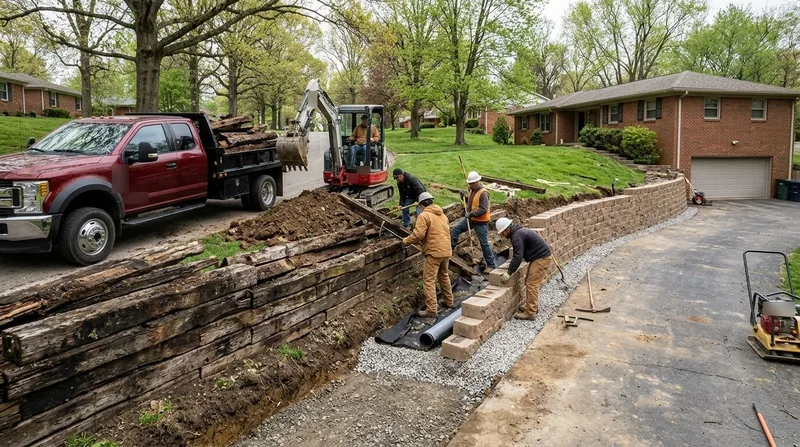




Lexington sits on rolling Inner Bluegrass ground where thin silty topsoil covers sticky clay over karst limestone, and that geology decides how long a retaining wall lasts. Walls here fail from water-logged clay pushing from behind, freeze-thaw cycles opening joints, sinkhole settlement under footings, and heavy spring rain. From the brick townhouses around Gratz Park to the 1950s-70s ranches in Southland and Lansdowne, we tear out failed walls and rebuild them right. If you need Retaining Wall Replacement in Lexington, we demolish the old structure, haul it away, fix the drainage, and set a modern wall that handles Bluegrass clay. Call (859) 710-8778 for a free estimate. Start with our retaining wall repair page if your wall is leaning but not yet gone.
Why Retaining Wall Replacement Matters on Lexington's Clay and Karst Ground
Most walls we replace in Lexington were never built for this soil. Railroad tie terraces from the 70s and 80s in Chevy Chase and Ashland Park have rotted through, and poured concrete walls along driveways in Hamburg and Beaumont crack when clay swells and sinkholes open under the footing. Once the wall leans or bulges, patching rarely holds, and replacement is the honest fix.
- Water-logged clay pushes against the back of the wall and bows it outward within a few seasons.
- Freeze-thaw cycles open joints and crack concrete faces through grey Kentucky winters.
- Sinkhole settlement drops footings on karst limestone and pulls walls out of line.
- Rotted timber and railroad ties lose structural strength and start collapsing into the slope.
- Failed drainage traps water behind the wall and guarantees the next failure.
Replacing the wall lets us correct the drainage and footing at the same time, which is why a full rebuild outlasts any patch job.
Key info: In Nicholasville and Georgetown, we routinely replace railroad tie walls that have rotted through after 30 years, and the new segmental block walls include gravel backfill and drain tile that the originals never had.
For permit thresholds and engineered drawing requirements, check with the Lexington-Fayette Urban County Government building department before work starts.
How We Replace a Failed Wall in Lexington, Step by Step
Every replacement starts with a site walk to check the slope, the soil, and what the wall is holding back. We measure from the footing, confirm the surcharge (driveway, patio, or structure above), and decide whether the new wall needs engineering. Then we schedule demolition and rebuild in one continuous push so your yard is not torn up for weeks.
- We inspect the wall, slope, and drainage and mark utilities before any digging.
- We demolish the old wall and haul away concrete, block, timber, or railroad ties.
- We excavate to stable soil or rock and build a compacted gravel base for the new footing.
- We install drain tile, washed gravel backfill, and filter fabric to move water away from the wall.
- We set the new wall material (block, concrete, boulder, or timber) and tie it into the slope.
- We backfill in lifts, compact each layer, and finish the grade so water runs off.
We leave the site clean and walk you through the drainage before we pull out.
Key info: A recent replacement in the 40505 ZIP code involved a collapsed railroad tie terrace behind a Lansdowne ranch. We removed 40 feet of rotted ties, rebuilt with segmental block, and added drain tile that now handles the spring runoff from the uphill neighbor.
If the slope above the wall is also moving, pair the replacement with slope stabilization and erosion control so the new wall is not fighting a losing battle.
Replacement Approaches We Use Across Lexington
The right replacement material depends on height, load, access, and how the wall looks against the house. We match the approach to the site rather than forcing one system onto every yard.
| Approach | Description | Best for |
|---|---|---|
| Segmental block replacement | Engineered block units set on a gravel base with drain tile and geogrid. | Subdivision walls in Hamburg and Beaumont, tiered terraces |
| Poured concrete replacement | Formed and poured wall with rebar and a proper footing. | Driveway and structural walls with heavy surcharge |
| Boulder and natural stone | Local limestone set into the slope with gravel backfill. | Garden walls and dry-laid rock fences in older neighborhoods |
| Timber and railroad tie replacement | New treated timber or a switch to block where ties have failed. | Low garden terraces, budget-conscious replacements |
We tell you which approach fits your slope and budget, not just which one is easiest to sell.
Retaining Wall Replacement Cost in Lexington: What to Expect
Replacement pricing starts at From $35/sq ft for a standard segmental block wall with drainage, and climbs from there. Height, access, soil conditions, and what the wall is holding back all move the number. A wall supporting a driveway in Beaumont costs more than a low garden terrace in Chevy Chase because it carries surcharge and needs engineering.
Factors that change the price include wall height measured from the footing, the amount of demolition and haul-away, whether we hit rock or a sinkhole during excavation, and how tight the access is for equipment. Replacing a rotting railroad tie wall is usually cheaper than a poured concrete structural wall of the same length.
Get two or three written estimates so you can compare scope, drainage detail, and warranty, not just the bottom line. Our full pricing overview breaks down the ranges by material and height.
Finding a Retaining Wall Contractor Near Me in Lexington
Retaining wall replacement is structural work, so hire a contractor who is fully insured and can show you proof. Ask for a certificate of insurance before work starts, and confirm the policy covers excavation and wall collapse. Get at least two or three estimates in writing, and check references from jobs in Lexington or the surrounding counties.
Ask who pulls the permit. Many Lexington walls above roughly 4 feet, or walls that support a driveway or structure, need a permit and sometimes engineered drawings, and the rules vary by jurisdiction, so the local building department has the final say. If your neighborhood has an HOA, check the architectural rules before you pick a block color or wall height.
Reach out through our contact page to schedule a free estimate.
Retaining Wall Replacement in Lexington: Pricing Guide
| Service | Price | Details |
|---|---|---|
| Segmental block replacement | Starting at $35/sq ft | Includes demolition, haul-away, gravel base, drain tile, and block; height and surcharge move the price up |
| Railroad tie or timber replacement | Starting at $30/sq ft | Includes removal of rotted ties, new treated timber or block, and drainage; access and length affect the rate |
| Poured concrete structural wall | Starting at $55/sq ft | Includes forming, rebar, footing, and drainage; engineering and heavy surcharge push the price higher |
| Boulder and natural stone wall | Starting at $45/sq ft | Includes local limestone, gravel backfill, and setting; stone availability and slope access change the cost |
| Complex or large-scale job | On estimate | Tiered walls, sinkhole repair, and engineered designs need an on-site look before we quote |
| Estimate | Free | Response within 24 hours at (859) 710-8778, no obligation to book |
Indicative pricing, the exact cost depends on square footage, finish, and site access. Free personalized estimate within 24h at (859) 710-8778.


