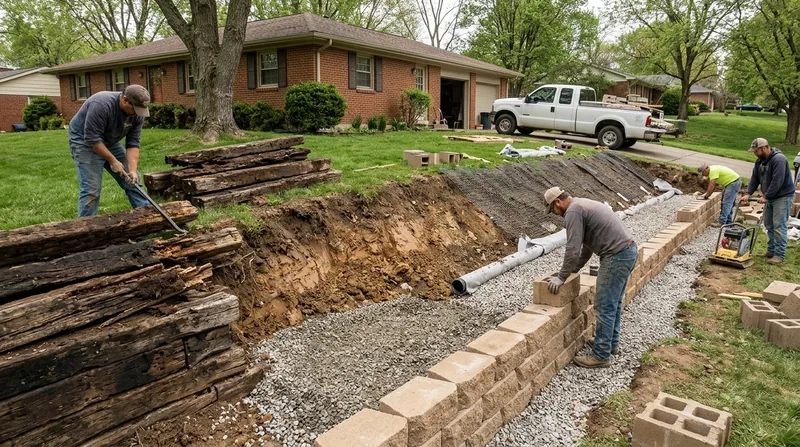




If your backyard in Chevy Chase or Southland still holds a 1970s railroad tie terrace, you are not alone. Across Lexington, creosote-soaked ties that once held a slope are now rotting, bowing, and leaching into the clay. Railroad Tie Wall Replacement in Lexington is the fix: we pull the old ties, haul them off, rework the drainage, and rebuild with segmental block, poured concrete, or native limestone. The Inner Bluegrass sits on thin silty topsoil over sticky clay and karst limestone, so water has nowhere to go fast. That is what kills timber walls here. A tie wall that stood fine for 25 years can fail in two wet springs once the wood checks and the backfill clogs. We replace them properly, with gravel, filter fabric, and a footing that handles freeze-thaw. If your wall is already leaning, start with leaning and collapsed wall repair before the slope moves further.
Why Railroad Ties Fail Faster in Lexington's Clay and Karst
Railroad ties are untreated softwood soaked in creosote, and creosote does not stop rot forever. In Lexington's wet clay, ties sit in moisture most of the year. Freeze-thaw cycles in January and February crack the grain, and heavy spring rain pushes water against a wall that was never built to drain. The result is the classic failure: the bottom courses rot out, the wall kicks forward, and the terrace above starts to slump.
- Ties rot from the bottom up because the footing holds water against the wood.
- Clay backfill traps hydrostatic pressure that pushes the wall face outward.
- Creosote leaches into garden beds and runs off during heavy rain.
- Old ties settle unevenly over sinkholes and shallow limestone shelves common in the Bluegrass.
- Timber walls have a service life of roughly 20 to 30 years, and most Lexington installations are past that.
Once a tie wall starts to lean, patching it rarely buys more than a season. Replacement is the only durable answer.
Key info: A tie wall on a slope above a Hamburg subdivision walkout is a safety issue, not just a curb-appeal issue. When the wall goes, the slope follows.
Before any work starts, confirm what your project needs from the City of Lexington building department. Permit thresholds vary by height and surcharge, and walls above roughly four feet often need a stamped drawing.
How We Replace a Railroad Tie Wall in Lexington
We treat every tie wall replacement as a drainage and structural job, not a cosmetic swap. The old wall comes out, the soil gets evaluated, and the new wall goes in with proper base, backfill, and weep paths. On the rolling lots around Ashland Park and the older brick ranches in Lansdowne, that often means cutting the slope back in stages so the yard above stays stable during the work.
- We walk the site, measure wall height and slope, and check for sinkholes, shallow rock, and utility conflicts.
- We remove the old ties, pull the rotted footing, and haul everything to an approved disposal site.
- We excavate to a stable subgrade and pour or compact a new leveling pad that meets the wall's load.
- We install gravel backfill, filter fabric, and perforated drain pipe to move water away from the wall face.
- We build the new wall in segmental block, poured concrete, or natural limestone to match your house and grade.
- We compact in lifts, cap the wall, and restore the soil and plantings above and below.
Most replacements take two to five days depending on length, access, and how much of the old wall has to be dug out by hand.
Key info: On a Versailles lot with a tie terrace behind the garage, we found the old footing sitting on fill over a shallow limestone shelf. We pinned the new block wall to rock and re-routed the downspouts, and the wall has not moved since. That kind of surprise is why we open the ground before quoting a firm number.
If the slope above the wall is also moving, we fold in slope stabilization and erosion control so the new wall is not fighting a losing battle.
Replacement Approaches We Use in Lexington
The right replacement depends on wall height, how much load it carries, and what fits the house. A 1990s two-story in Beaumont usually pairs well with segmental block. A 1920s Tudor in Chevy Chase often looks best with limestone. A driveway wall in Nicholasville carrying a surcharge needs concrete or engineered block.
| Approach | Description | Best for |
|---|---|---|
| Segmental block | Interlocking concrete block with gravel core and geogrid as needed. | Terraces and garden walls up to 4 ft, most subdivision lots. |
| Poured concrete | Reinforced concrete wall with formed face and drainage behind. | Driveway surcharges and tall walls needing engineered design. |
| Natural limestone | Dry-laid or mortared Kentucky limestone to match local stone fences. | Historic homes and visible garden walls in Ashland Park and Gratz Park. |
| Timber rebuild | New pressure-treated timber with proper gravel backfill. | Low garden walls where budget matters and height is under 3 ft. |
We match the material to the load first and the look second, so the replacement outlasts the original tie wall by decades.
Railroad Tie Wall Replacement Cost in Lexington: What to Expect
Most tie wall replacements in Lexington start around $35 per square foot of wall face, and that figure moves with height, access, and material. A short garden wall in Wilmore is a different job from a tall terraced wall in Hartland with limited equipment access. Demolition and haul-away of creosote ties adds cost because disposal is regulated, and engineered walls add design and inspection steps.
Get two or three written estimates and compare scope, not just the bottom line. Ask whether the price includes tie disposal, new drainage, and footing work. A cheap quote that skips the drain pipe will cost you again in five years. Our full pricing overview breaks down what drives the number.
Railroad Tie Wall Replacement Near Me: How to Hire in Lexington
When you search for a retaining wall contractor near me in Lexington, you will get a long list. Narrow it by checking license and insurance first, then references on jobs similar to yours. Ask specifically about tie demolition and disposal, because not every landscaper handles creosote material correctly. Confirm who pulls the permit if your wall crosses the four-foot threshold or carries a driveway, and check HOA rules before you pick a wall material.
Reach out through our contact page to set up a site visit. A free estimate takes about 30 minutes and gives you a real number, not a phone guess.
If you want to see how we handle the whole replacement scope, from demolition to finish grade, start at the retaining wall replacement page.
Railroad Tie Wall Replacement in Lexington: Pricing Guide
| Service | Price | Details |
|---|---|---|
| Segmental block replacement | Starting at $35/sq ft | Includes tie demolition, haul-away, gravel backfill, drain pipe, and block installation; height and access move the price. |
| Poured concrete replacement | Starting at $55/sq ft | Includes forms, rebar, footing, and drainage; engineered design and driveway surcharge add cost. |
| Natural limestone replacement | Starting at $50/sq ft | Includes stone selection, dry-laid or mortared build, and backfill; hand-set detail and tight access raise it. |
| Timber wall rebuild | Starting at $28/sq ft | Includes new pressure-treated timber, gravel backfill, and drainage; best for low garden walls under 3 ft. |
| Complex or large-scale job | On estimate | Tiered walls, sinkhole repair, and engineered designs need an on-site look before any number is given. |
| Estimate | Free | Response within 24 hours at (859) 710-8778, with no obligation to book the work. |
Indicative pricing, the exact cost depends on square footage, finish, and site access. Free personalized estimate within 24h at (859) 710-8778.


